Match the measuring tool to the recipe before you start
Check the recipe's units against the tools already in your kitchen. Readable markings and a working scale can make the measuring step clearer before you begin.
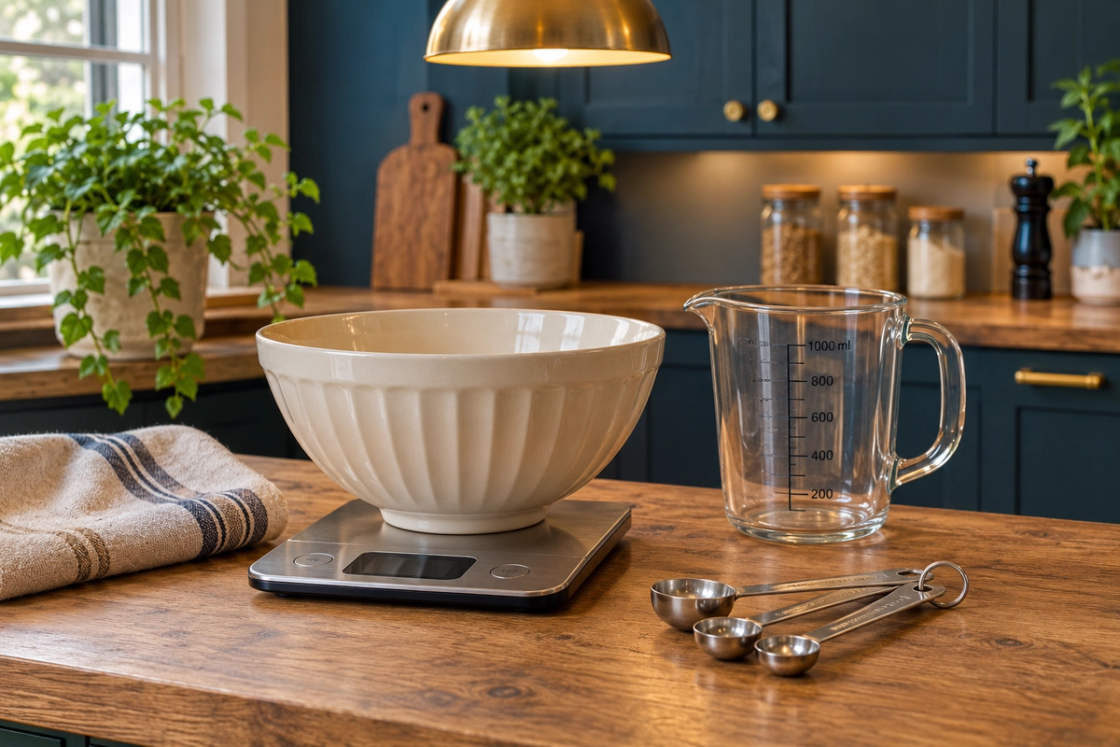
Before opening ingredients, put the recipe beside the measuring tools you already have. Match each quantity to a unit you can read on the tool: grams on a scale, millilitres on a measuring jug, or the stated size on a measuring spoon or cup. Keep the recipe's quantities and method unchanged.
This is a small equipment check, not a kitchen overhaul. Its job is to catch the missing spoon, unreadable line or flat scale battery before you have a bowl of ingredients waiting. You do not need a matching set or a new purchase to begin checking.
Read the unit as well as the number
Scan the ingredient list and any measuring notes in the method. A number without its unit is not enough to choose a tool. Grams describe mass; millilitres describe volume. A cup or spoon measure is also a volume, not a weight you can transfer unchanged to the scale.
Look for the recipe publisher's measurement guide, especially when using a recipe from another country. Cup and spoon conventions can differ. Check what the author means against the capacity marked on your tool rather than assuming that anything called a tablespoon is the same size.
If the recipe supplies a metric option, use its stated quantities consistently. Do not build a conversion from a search snippet or replace a gram quantity with the same number of millilitres. If the measurement remains unclear, leave this recipe for now rather than guessing.
Give each measure a tool
- For grams, check that your kitchen scale has a gram setting and a display you can see with the intended bowl on it. Follow its instructions for zeroing the bowl before weighing ingredients.
- For liquid millilitres, find a measuring jug with the required marking. Check the scale of marks, not only the largest capacity printed near the top.
- For cup or spoon quantities, find the labelled measuring cup or spoon that matches the recipe's convention. A drinking mug or an eating spoon is not a confirmed match.
Keep any ingredient-specific directions with the quantity. Words such as level, packed or sifted are part of the instruction. Health Canada's measuring guide likewise recommends following the measuring tips in the specific recipe. Choosing a tool does not replace reading how the author wants it used.
Check whether you can use it comfortably
Look at the markings in the place where you will measure. Can you distinguish the line you need from the neighbouring lines? Does glare hide the number? Would another jug already in the cupboard be easier to read? Moving to a better-lit part of the bench may help without changing the tool.
Check the handle and the empty tool's weight too. A large glass jug may be clear but awkward to hold; a lighter one may have faint markings. Neither material is the right choice for everyone. Choose among suitable tools according to what you can read and handle today.
Switch the scale on before you start. Check its unit setting and controls, and whether the bowl hides the display. If you cannot get a stable, readable result using the manufacturer's instructions, pause rather than estimating around a faulty reading.
Set out tools, not a new system
Place the required clean tools within reach, leaving room for the recipe and bowl. You can leave the rest in the drawer. There is no need to decant every ingredient or arrange a row of extra bowls unless that genuinely helps you.
Once measuring begins, finding the next instruction is a different job. The note on keeping your place in a recipe without rewriting it offers a small marker approach while keeping the full method visible.
Let a mismatch be useful information
If a required measure is missing or unreadable, you have found that out before mixing anything. You can borrow a suitable tool, use an alternative explicitly supplied by the recipe, or choose a familiar meal that fits the equipment available. Buying something is not the automatic next step.
If the whole method now feels too demanding, read a recipe for effort, not minutes addresses that wider choice. For this check, the finish line is smaller: the original quantity, a matching tool and markings you can use. Then you can decide whether this recipe fits today.