Compare the unit price without committing to the bigger pack
A lower unit price does not have to mean a bigger purchase. Compare two familiar options, then check the money and space the whole pack needs.
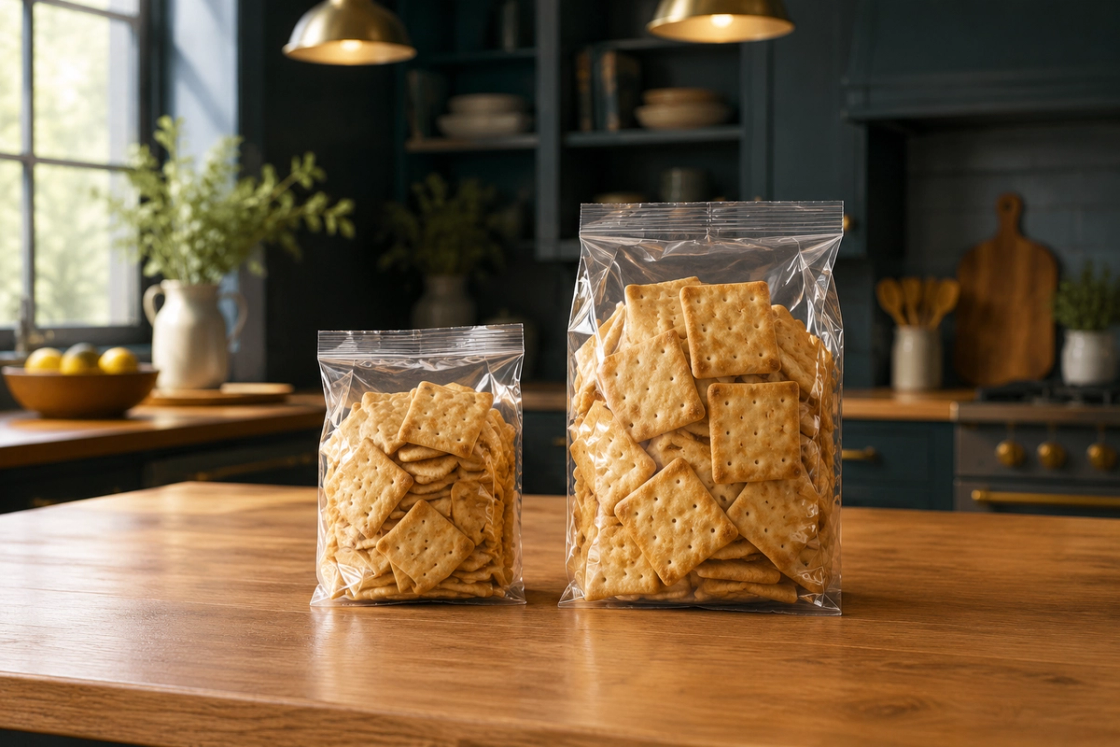
Start with two versions of a food you would actually eat. Find each shelf label's unit price, check that both use the same measurement, then compare the numbers. After that, make a separate decision about the whole pack: can you pay for it today, store it and use the amount inside?
The lower unit price tells you which option costs less for the same quantity. It does not tell you which purchase fits this shop. You can understand the comparison perfectly and still choose the smaller pack.
Choose the two candidates first
Keep the comparison narrow. You might choose two sizes of your usual plain crackers, or two familiar brands with a texture you already like. There is no need to investigate every packet along the shelf.
If one version has an unwanted flavour, an awkward closure or preparation you cannot manage today, leave it out of this comparison. A matching product name does not make two foods equally useful to you. Keep your usual dietary and product checks separate from the price exercise.
Read the words beside the number
The ACCC describes unit pricing as the cost for a standard measurement, shown alongside the selling price. Depending on the product, you might see a price per kilogram, per litre, per 100 grams or per item.
Look for the unit-price line on the label for the exact pack you are holding. Check the product name and size, especially if several similar packs share a shelf. Then read the measurement on both labels before deciding which number is lower.
- Both say per 100 g: compare those prices directly.
- One says per kilogram and one says per 100 g: the numbers need conversion before they are comparable.
- One says per item and the other says per weight: do not treat the smaller number as the cheaper equivalent.
If the print is difficult to read, you can ask for help or use your phone camera to enlarge it where practical. If the units are unclear, pause the comparison rather than guessing. Finding the lowest price is not a requirement for finishing the shop.
Keep the checkout price in view
Here is an invented example in AUD, not a current supermarket offer. A 300 g packet costs $2.70, or $0.90 per 100 g. A 500 g packet costs $4, or $0.80 per 100 g. The larger packet has the lower unit price, but it needs another $1.30 at the checkout.
If that extra money is needed for something else in your basket, the smaller packet may be the workable purchase. The unit-price saving has not reduced the amount you must pay today. Check the total selling price before putting either option in the trolley.
Ask what the extra food would need
Picture the pack at home without creating a new meal plan to accommodate it. Is there a suitable place for it? Is this an amount you normally use? Would finishing it depend on repeatedly eating something you only want occasionally?
A bigger pack can suit a familiar food you use often. It can also leave you with extra handling, storage or meals to organise. The ACCC advises avoiding a larger pack if it is likely to go to waste. Keep the product's storage and use directions in the decision.
If unwanted extra portions are the recurring problem, cooking for one without making four portions looks at choosing quantities from shelf to plate. You do not need to turn today's price check into a batch-cooking commitment.
Give this comparison an ending
Use a short sequence: acceptable food, matching units, whole-pack cost, useful amount. Once those questions are answered, choose the option that fits and move on. You can compare one item this way without reviewing the entire basket.
If the real choice is whether to pay for less chopping or grating, spending your shortcut budget on the hardest prep step tackles that different question. Here, the aim is smaller: read the price comparison without letting it decide the size of your purchase for you.