Clear the view around your plate, not the whole room
A familiar meal can sit in an unhelpfully busy view. Move the papers or packaging you do not need, while keeping useful meal items within reach.
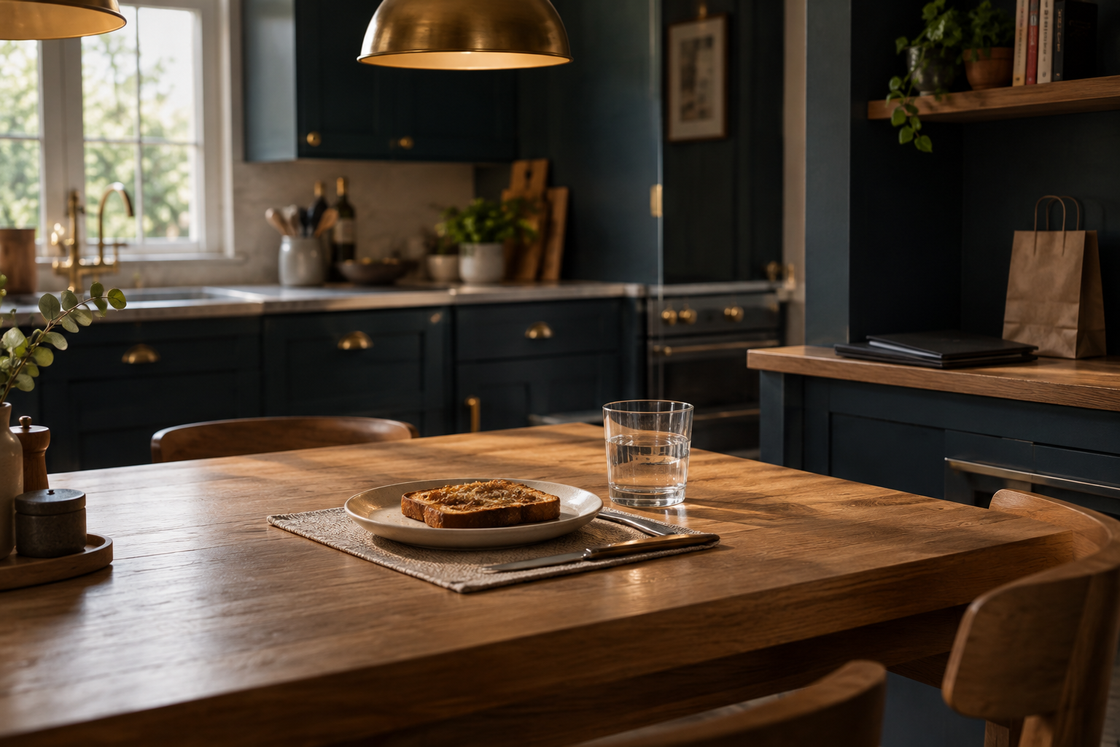
Your food is ready, but the table is still doing several jobs. There is a work notebook beside your bowl, an empty delivery bag in front of you and yesterday's post behind your glass. If that view feels unwelcome, you can change a small part of it without tidying the room.
Start with one thing you do not need for this meal. Move it out of your immediate view, leave the food as it is and keep the things you use easy to find. This is a temporary eating arrangement, not a new standard of housekeeping.
Look from where you will eat
Sit in your usual place before deciding what to move. The view from your chair may be different from the view you notice while standing over the table. You do not need to assess the whole room or search for everything that could be distracting.
Is there something specific you would rather not look at while eating? Perhaps it is an open work folder, several colourful packets or a pile of receipts directly beyond the plate. Choose that, rather than making an inventory of the mess.
An empty table is not the goal. A favourite object, familiar arrangement or useful reminder can stay. If the current view suits you, there is no reason to clear it because someone else prefers less on show.
Move without sorting
Give the unwanted items a temporary destination before picking them up. A nearby shelf or an existing basket might work. Choose somewhere stable, away from your plate and not where someone needs to walk or sit.
- Close the work folder and move it as one item. You do not need to read or file its contents.
- Put unneeded outer packaging aside together. Keep any packet you still need to read available.
- Move your own papers without reorganising someone else's belongings. Ask before shifting a shared pile.
If moving things would start a larger job, leave them. Where there is already another suitable place to sit at the table, changing seats may give you a preferable view without relocating anything. There is no need to dim the lights, change the food or make the room look finished.
Keep the useful things visible
Clearing everything can create another nuisance: having to hunt for the spoon, drink or sauce you wanted. Keep those items in their familiar places, within comfortable reach. An eating space can hold several things and still be the arrangement you prefer.
For example, keep your bowl, spoon, glass and condiment beside you while moving the empty delivery bag and unopened mail. You have changed what surrounds the meal, not added a requirement to decant everything or set a formal place.
A placemat you already own is optional. If it helps you mark out your part of a shared table, use it; if its pattern or texture is unwelcome, leave it out. There is nothing to buy for this experiment.
Make a small request in a shared space
At a table used for work or hobbies, ask for the space you need rather than a complete reset: ‘Could we move this folder to the shelf while I eat? The rest can stay.’ Name where it will go so nobody has to search for it afterwards.
If lifting or carrying is more than you have energy for, that can also be the whole request for help. Someone moving one bag is useful; they do not need to take over the room.
Stop when the meal has space
Once the particular item is out of view and what you need is reachable, you can stop. You do not owe the table a second pass. Nor do you need to score your comfort, photograph the result or repeat the arrangement tomorrow.
If what bothers you is contact with the spoon rather than the view, consider the cutlery and bowl pairing as a separate question. That does not mean you need to change both things at this meal.
The rest of the room can remain unfinished. Your familiar food is already here; making a little room around it is enough of a task.