When You Lose Track of Time in the Kitchen
Time blindness makes stove cooking feel risky, because twenty minutes can vanish. Here are meals and setups that forgive a lost stretch of time instead of punishing it.
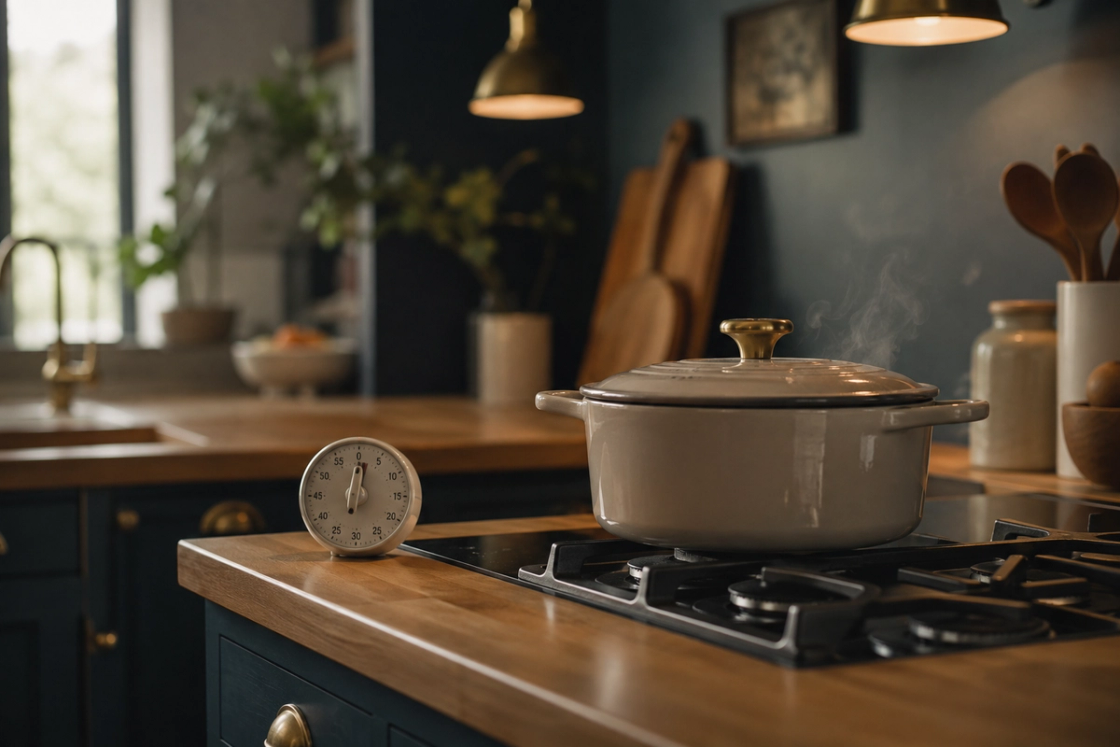
You put the pan on. You go to check one thing on your phone. When you look up, the kitchen smells wrong and twenty minutes have gone somewhere you cannot account for.
If this happens to you often, it is not carelessness. Time blindness means the sense of elapsed time simply does not run in the background the way it does for other people. You are not ignoring the clock. You are not receiving it.
The usual advice is to concentrate harder. That has never worked for anybody. The better move is to cook in ways where losing time costs you nothing.
The real problem is unattended heat
Most kitchen disasters are not about skill. They are about a heat source that keeps going while your attention is elsewhere. A stovetop is the worst offender: it is fast, it is hot, and nothing stops it.
So the question is not how to remember better. It is which cooking methods stay safe when nobody is watching.
Choose the method that forgives you, not the one that tests you.
Forgiving methods, ranked
- Oven at a lower temperature. A tray at 160C is very hard to ruin in an extra ten minutes. The same tray at 220C is not.
- Anything with a lid and liquid. Soups, stews and rice with plenty of water tolerate overshoot. Dry pans do not.
- Appliances that stop by themselves. Rice cookers, air fryers, slow cookers and microwaves all end their own cycle. This is the single biggest upgrade available.
- Kettle-and-bowl food. Couscous, instant noodles, oats. The heat is already finished before the food meets it.
If you buy one thing this year, make it something that switches itself off.
Make the timer louder than your attention
A timer only works if it can interrupt whatever captured you. A quiet ping from a phone that is already showing you something interesting will lose that fight every time.
- Use a separate physical timer, not the phone you are about to disappear into.
- Set it for less than the cooking time and check early. An early check costs nothing; a late one costs dinner.
- Carry the timer with you when you leave the room. The alarm needs to be where you are, not where the food is.
- Smart speakers are good at this, because you can set a timer without touching a screen that will keep you.
Stay in the room on purpose
When something genuinely needs watching, the trick is not willpower. It is giving yourself a reason to remain that is more appealing than leaving.
A podcast or an episode that only plays in the kitchen. Leaning against the bench with a drink. Doing the washing up while you wait. The aim is to make the ten minutes pleasant enough that you do not go looking for something else.
Standing still and staring at a pot is not a plan. It is boring, and boredom is exactly what sends you out of the room.
Front-load the fiddly part
Chopping and measuring while nothing is hot removes the worst version of this problem, which is losing time while a pan is already going. Get everything into bowls first, then start the heat. The cooking phase becomes short and boring, which is what you want.
If prep and cooking in one session is too much, split them across the day. Chop at lunchtime, cook at six. Nothing says it has to be continuous.
When it burns anyway
Sometimes it will. Scrape off what is ruined and eat the rest if it is edible. Keep one no-cook backup in the cupboard for the nights it is not, so a burnt pan does not turn into no dinner.
A ruined pan is a bad twenty minutes, not evidence about you.
The short version
Cook with lids, liquid, lower heat and machines that stop themselves. Put the alarm where your body is. Do the fiddly work before anything is hot. Then a lost twenty minutes becomes a slightly overcooked dinner instead of a disaster — less deciding, more eating.
Related reading: "One Tray, No Watching: Oven Dinners That Don't Need Supervision" is the natural next step if the oven is becoming your safest option.
Also from this week: "Cooking While Someone Else Is Home" — the same forgiving methods, applied when the kitchen isn't yours alone.