When You Forget to Eat Until You're Too Hungry to Cook
Hunger often arrives all at once, long past the point where cooking is possible. A bridge food gets you fed enough to think, so the real meal becomes an option again.
You meant to have lunch. Then it was 4pm, and you were shaky and irritable and could not work out why. And by the time you noticed, cooking anything had quietly become impossible.
This is one of the most common food problems people write to us about, and it is rarely a motivation problem. It is a timing problem with a very specific shape.
Why hunger arrives late and all at once
Two things tend to stack up here.
The first is interoception — how clearly you read signals coming from inside your own body. For a lot of ADHD and autistic people, that signal is quiet, delayed, or easy to mistake for something else. Early hunger can feel like nothing at all, or like being a bit annoyed, or like needing a drink. It often does not register as hungry until it is loud.
The second is time blindness. Hours spent absorbed in something don't leave much of a trace. You are not ignoring lunch. Lunch simply never appeared in your awareness as a thing that was happening now.
Put together, you skip the gentle warning and land straight in the version of hunger where your thinking has already narrowed.
Why cooking stops being possible at that point
Cooking is not one task. It is a stack of small decisions and sequencing steps: what to eat, whether the ingredients exist, what order to do things in, how long to wait. Every one of those costs something.
Very low blood sugar is exactly when that stack is least affordable. So you get the trap: the hungrier you are, the less able you are to do the thing that would fix it. Standing in front of an open fridge, unable to choose, is a normal outcome of that trap rather than a personal failing.
The goal is not to cook while starving. The goal is to stop being starving, then decide about cooking.
Stock a bridge food
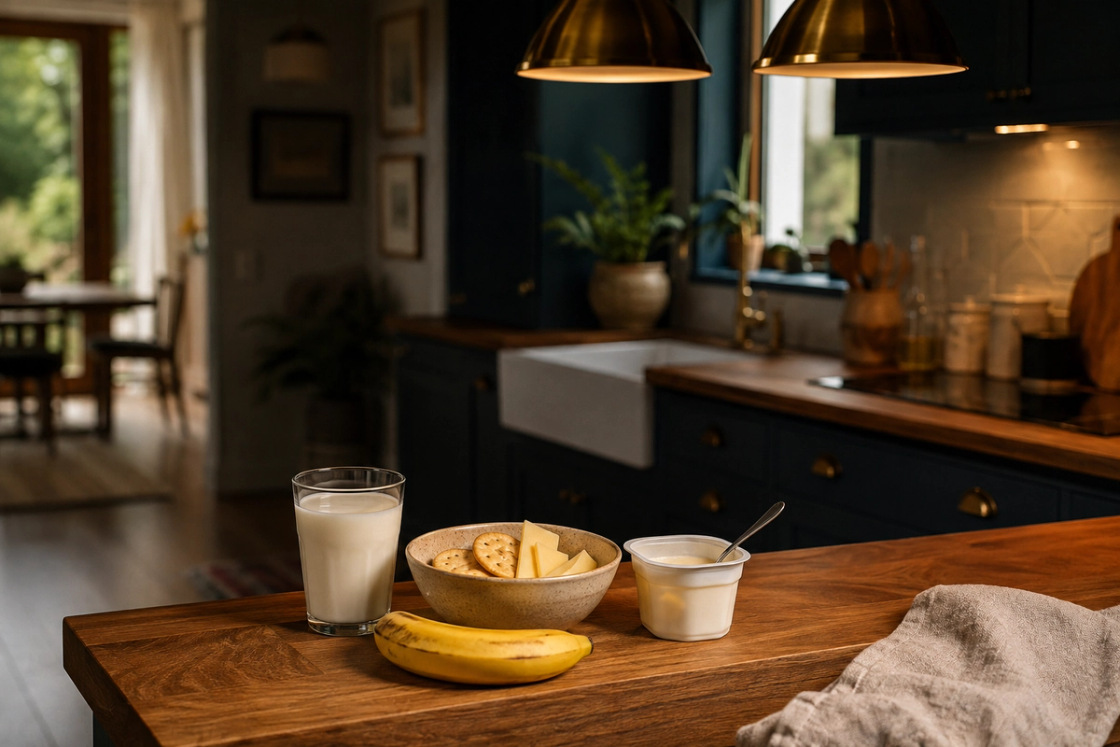
A bridge food is a small thing you eat immediately, with no preparation, purely to get your brain back online. It is not dinner. It is what makes dinner possible twenty minutes later.
What makes something work as a bridge food:
- Zero steps. No heating, no chopping, no assembly.
- No decision. One default, always the same, so there is nothing to choose.
- Some protein or fat, not sugar alone — you want the lift to last past the next half hour.
- Sensory-safe on a bad day. If the texture is a gamble, it won't get eaten when you most need it.
- Small. Enough to take the edge off, not so much that dinner disappears.
A shortlist that keeps well
- Cheese slices with plain crackers
- A tub of yoghurt, spoon already in the drawer above it
- A glass of milk, or a long-life milk carton if fresh milk keeps going off
- Peanut butter on bread, or straight off the spoon
- A banana, or tinned fruit if fresh fruit tends to go soft before you get to it
- A muesli bar in the bag you actually carry
Most of these sit under $5 and last weeks in the cupboard, which matters — a bridge food you have to replace often is one that will be missing on the day you need it.
Put it where you'll see it
A bridge food in the back of the pantry does not exist. At 4pm, you will not go looking.
Give it one obvious home at eye level — a shelf on the fridge door, a bowl on the bench, a labelled box that is only for this. Same spot every time. The whole point is that it takes no searching and no thinking.
Catching it earlier, without relying on hunger
If the internal signal is unreliable, use an external one instead.
- Attach eating to something that already happens — the end of a meeting, the school pickup, closing the laptop.
- Set one alarm for the time of day it usually goes wrong, rather than several across the day.
- Treat irritable, foggy, or suddenly tearful as hunger data. It often is.
None of this needs to work every day. A bridge food is useful precisely because it covers the days the earlier steps didn't happen.
And if dinner still doesn't happen
Sometimes you eat the crackers and the yoghurt and that is the whole meal. Fed is the win. Cooking was always the optional part.
Less deciding, more eating.
Related reading: "Cold, No-Cook Dinners That Still Feel Like a Meal" — for the nights when the bridge food gets you upright but the stove still isn't happening.