When the Smell Is the Problem
Cooking smells can end a meal before it starts. If the smell is the barrier, the useful levers are ventilation, ingredient swaps and timing — not pushing through it.
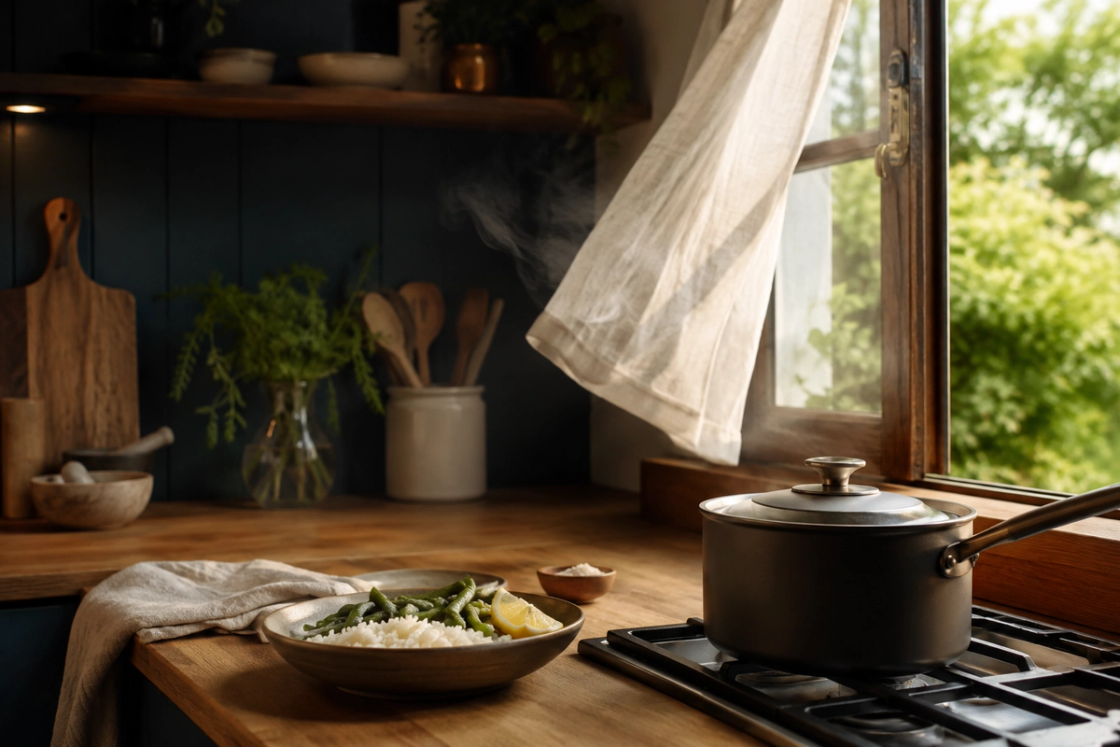
Some kitchens are hard because of the standing. Some because of the noise. And for some of us, the thing that ends a cooking session is the smell. It arrives before the food does, fills the whole flat, and is still in the room long after the plate is empty.
That is not fussiness. Smell has the shortest route into your nervous system of any sense, and it does not switch off when you leave the room. If a cooking smell makes you nauseous, anxious, or unable to eat the thing you cooked, that is a real barrier — and it is worth working around rather than through.
Why smell is harder to dodge than noise
You can put headphones on for noise. There is no comfortable equivalent for smell — you still have to breathe. Cooking odours also linger, because fat carries them and they settle into soft furnishings, hair and clothes.
- You cannot step out and come back to a clean slate. The smell is still there.
- The food can smell wrong to you by the time it is actually ready to eat.
- In a small flat or a share house, there is nowhere the smell is not.
So there are three levers worth pulling: move the air, change what you cook, or change when you cook it.
Move the air first
Ventilation does more than any ingredient swap, and it costs almost nothing. Roughly in order of effect:
- Open a window before you turn the heat on, not after. Air that is already moving carries less.
- Open two if you can — one near the stove, one at the far end. A cross-draught beats a single window by a lot.
- Turn the rangehood on high at the start, not once you notice the smell. If yours recirculates rather than venting outside, it catches grease but not much odour, so the window matters more.
- Shut the door to whichever room you plan to sit in afterwards.
- A cheap desk fan sitting in the window facing outwards is a decent stand-in for a rangehood you do not have.
Some ingredients carry, some do not
How strongly something smells in the air is not the same as how strong it tastes on the plate. The loud ones are fairly predictable: onion and garlic browning in oil, fish in an open pan, brassicas like broccoli, cabbage and brussels sprouts, curry powder bloomed in hot fat, vinegar reduced in a hot pan, and anything deep-fried.
Quieter swaps that get you to a similar meal:
- Add garlic and onion later, into liquid, instead of frying them at the start. Softer smell, gentler flavour.
- Or use garlic and onion powder, which skips the frying stage entirely.
- Bake fish in a covered dish or a foil parcel rather than pan-frying it.
- Green beans, peas, zucchini and carrots instead of the brassicas.
- Stir lemon or vinegar through at the end rather than cooking it down.
- Poached or baked chicken thigh and firm tofu, rather than anything browned hard.
Heat and open fat make the smell, not the food
The same ingredients can be loud or quiet depending on the method. Higher heat and more exposed fat means more of the smell ends up airborne.
- Lid on. This is the biggest change for the least effort of anything on this page.
- Oven instead of stovetop — a closed box with its own path out.
- Microwave — sealed, no hot open fat, and almost no smell in the air.
- A low, slow simmer rather than a hard sear.
- Boiling or steaming rather than frying.
Cook when you will not have to sit in it
Timing is the lever people forget. The smell has a half-life; you do not have to be in the room for it.
- Cook in the afternoon with the window open and eat later, once the air has cleared.
- Put the smelliest component on a day you are heading out afterwards.
- Cook it once for several meals rather than smelling it five separate times.
- If someone else in the house cooks, asking for the door shut and a window open is a small request that changes a lot.
When you cannot avoid it
Sometimes the food you can reliably eat is the food that smells. A few things that take the edge off:
- Eat somewhere other than the kitchen.
- Rinse and cover the pan straight away. A dirty pan keeps releasing smell for hours.
- Take the bin out the same night, even if the rest of the tidying waits.
- Keep a smell you actually like within reach for afterwards — citrus peel, coffee grounds, a candle you know works.
None of this makes the smell disappear. It makes it small enough to cook around, and that is usually the difference between eating and not.
Less deciding, more eating.
Related reading: If it is the noise rather than the smell that ends your cooking sessions, "A Kitchen Setup for Noise-Sensitive Cooking" works the same problem from the other direction.