When the Kitchen Is Someone Else's
An unfamiliar kitchen turns every step back into a decision. Find four things on arrival, bring a small kit, and cook smaller than you would at home.
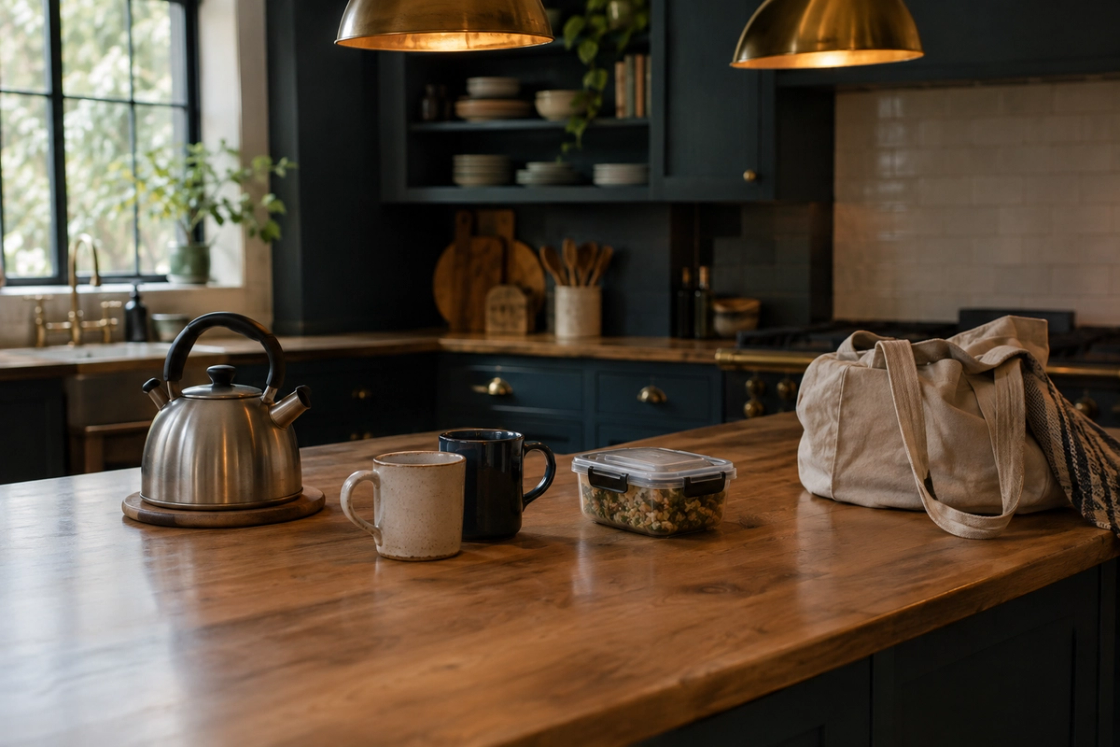
Staying at your parents', a friend's spare room, a holiday rental for a week. The kitchen works perfectly well. It is simply not yours, and nothing is where your hands expect it to be.
That sounds small. It is not. A familiar kitchen lets you make food without thinking. An unfamiliar one turns every step back into a decision — where is a knife, which cupboard, does this hob do that, is it rude to use this.
A few things make a borrowed kitchen much easier to eat in.
Find four things before you are hungry
Do this on arrival, while you still have capacity. Being hungry in a kitchen you cannot read is the situation worth avoiding.
- The kettle, or whatever heats water.
- A knife you are willing to use and a board.
- A plate, a bowl and a mug you can reach without asking.
- The bin, and whether anything gets separated.
That is it. Four things, found once, and the kitchen stops being a puzzle.
Bring a small kit
Not groceries. A few items that remove the worst of the uncertainty and fit in a corner of a bag.
- One safe food you know you will eat, in enough quantity for a couple of meals.
- Whatever sauce or seasoning makes unfamiliar food taste like yours.
- Your own tea or coffee, if that matters to you — it usually does.
- A couple of shelf-stable backups for the evening when the shared meal turns out to be something you cannot eat.
Cook smaller than you would at home
A strange kitchen is the wrong place to attempt anything with more than one pan. You do not know where the second pan is, whether the oven runs hot, or which burner is the temperamental one.
One pan, one heat source, few steps. Assembly beats cooking. Toast, eggs, something on rice, a plate of things from the fridge — all fine, all unremarkable to anyone watching.
The shared fridge
A shared fridge is where most of the friction in a borrowed kitchen actually lives. You open it, you cannot see your own food, and you close it again without eating.
Ask for one shelf, or one clear box on a shelf, and keep everything of yours in it. One place to look, nothing to hunt through, and no worry about whether the thing you were saving has been used by someone else.
If you are somewhere for more than a couple of days, this is worth doing on day one rather than day four.
Holiday rentals are their own case
A rental kitchen usually photographs better than it cooks. Expect one blunt knife, a single small pan, no sharp grater and a hob you have never met. Plan meals that survive that, and do not build the week around an oven you have not seen.
If you are driving there, a knife and a chopping board from home take up almost no room and remove most of the problem.
Asking, without a whole conversation
Most of the friction here is social rather than practical. Two sentences prepared in advance cover nearly all of it.
"Is it alright if I keep a few of my own things in this cupboard?" sets up the week in one go.
"I'm going to sort my own dinner tonight, but I'll sit with everyone" separates the eating from the company, which is usually the actual problem. People mind far less than the version of them in your head.
When you would rather not cook at all
Sometimes the answer in someone else's kitchen is to not use it. Eating the same simple thing every day for a week is a legitimate plan. So is buying something ready-made on the way back each afternoon.
You are not there to demonstrate that you can cook in unfamiliar surroundings. You are there for whatever the trip is actually for.
Less deciding, more eating.
Related reading: "Cooking While Someone Else Is Home" and "Safe Foods When You Also Have Food Intolerances".