School Holiday Lunches When You're Depleted Too
Spring school holidays add a second and third lunch to make each day, right when your own energy hasn't grown to match. Here's a short rotating set your kids can build themselves.
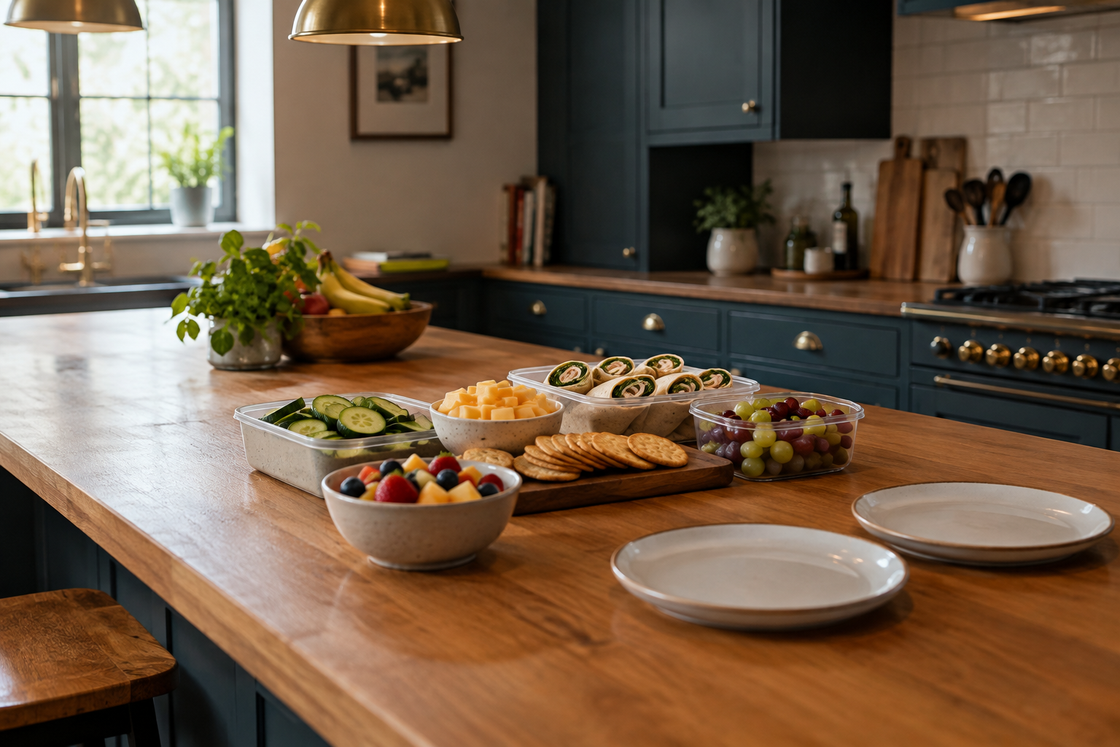
School holidays double your lunch count overnight. On a normal week there might be one lunch to think about, or none if everyone eats away from home. In the holidays it's a lunch per kid, every single day, for two weeks straight, on top of whatever else spring has added to the calendar — excursions, visitors, the heat starting to turn up, more unstructured hours in the house than usual. Your energy hasn't doubled to match any of it. This is about lowering the number of decisions per lunch, not finding more energy you don't have.
The real cost isn't the food
Making one sandwich is easy. Making four different lunches, to four different sets of texture rules, while someone is asking you a question and the dog wants out, is not the same task multiplied by four. It's noisier and it needs more of you per lunch, right when the school-term structure that usually carries everyone has gone quiet. The fix isn't a longer recipe list. It's fewer decisions, repeated on purpose instead of remade from scratch each day.
Build a lunch they can build themselves
A component lunch is a small set of parts laid out or stored together, that a kid assembles rather than one you hand over finished. You're not cooking to order four times over. You're stocking five things and letting them combine those the same way each day. It also hands back a bit of control on the food itself, which matters more these holidays than any other week.
The parts worth keeping stocked:
- A base — bread, wraps, rice cakes, crackers, whatever holds up without going soft by lunchtime.
- A protein — sliced cheese, ham, a boiled egg, hummus, whatever is already an accepted food in your house.
- A crunch — cucumber sticks, carrot, chips, plain crackers. Texture is doing a lot of the work here.
- A fruit or veg they'll actually eat, not the one you wish they'd eat.
- One extra, chosen by them — a small treat, a dip, a second crunchy thing. This is the part that makes it feel like theirs.
A short rotation beats a long list
You don't need ten different lunch ideas for two weeks off. You need four or five combinations you rotate through, repeated without apology. A short list is easier to shop for, easier to remember, and easier to hand to a kid who wants to do it themselves. Some starting combinations:
- Wrap, cheese, cucumber sticks, a mandarin.
- Rice cakes, hummus, carrot sticks, a small yoghurt.
- Crackers, ham, cherry tomatoes, a piece of fruit.
- Leftover rice or pasta from dinner, cold, with whatever vegetable was also left over.
- Plain sandwich, chips, an apple — the one that needs no decision at all on a bad day.
Set it up once, not every day
Do the thinking on the shopping trip, not at 11:45am. Decant the crackers into a tub. Portion cheese or ham into small containers at the front of the fridge, at a height a kid can reach. Wash and cut the crunch items in one batch and store them ready to grab, not ready to be prepared. The work happens once, and every lunch after that is assembly, not cooking.
If a kid needs the same food to look and feel the same each time, keep the containers and the layout consistent too — the predictability is doing real work, not just the food itself.
When even that's too much
Some days the component lunch is still one step too many. That's what a pantry-only fallback is for: cereal, plain toast, a yoghurt tube, crackers straight from the packet. No prep, no assembly, no decision. Keep it stocked and keep it boring on purpose — it's there for the days you're too depleted to lay anything out, not for every day. Buy it in a quantity that means you don't have to think about restocking it mid-fortnight either.
It's also fine if one combination becomes the only lunch for the whole fortnight. A repeated lunch that gets eaten without a fight is doing its job. Novelty is optional. Less deciding, more eating.
Related reading: if grazing plates work for dinner too, see “A Plate of Snacks Is a Dinner.”
Also this week: "Ordering Takeaway Without the Twenty-Minute Scroll" for the nights when dinner needs to be someone else's job.