Safe Foods When You Also Have Food Intolerances
When the foods you tolerate sensorially collide with the foods you tolerate physically, the safe list gets very short. Here's how to swap ingredients without losing the meal.
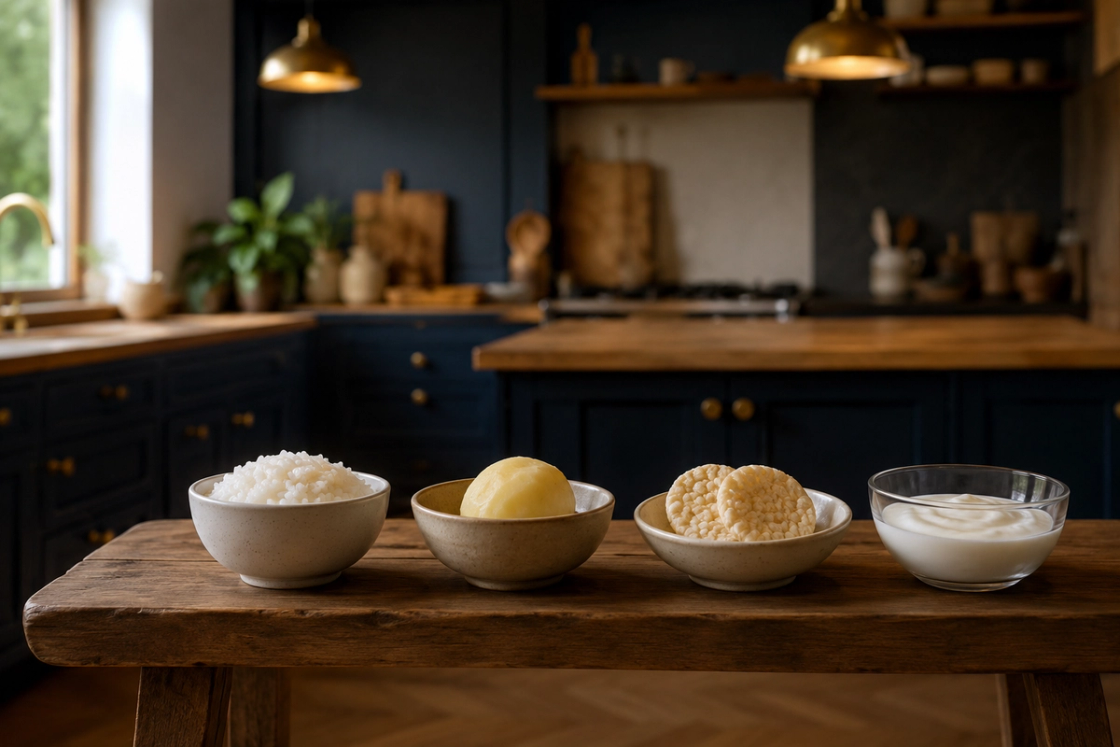
Safe foods are the ones you can eat without negotiating with yourself first. Same texture, same taste, same result every time. They are not a limitation. They are the reason dinner happens at all on hard days.
Food intolerances come with their own list. Not a preference list — a physical one. This makes you unwell, so it is out.
The hard part is where the two lists overlap. The plain pasta that always worked has gluten in it. The yoghurt you eat every morning is dairy. The safe list gets shorter, and it was already short.
Why this is harder than a normal dietary change
Most advice about intolerances assumes you can simply eat something else. That advice is written for people whose food list is wide.
If your list is short for sensory reasons, losing one item is not losing one option out of forty. It might be one out of six. And the standard replacements often fail on texture: the gluten-free bread is grittier, the dairy-free cheese is rubbery, the legume pasta goes soft in the wrong way.
So the goal is not to eat more broadly. It is to keep the small number of things that work, in a version your body agrees with.
Start with the shape, not the ingredient
A safe food is rarely about one specific product. It is usually about a shape — a set of properties that make it easy to eat. Try naming what is actually working:
- Temperature — hot, room temperature or cold
- Texture — smooth, crisp, soft, dry, uniform
- Flavour intensity — plain, mildly salty, sweet
- Wetness — dry and separate, or saucy and combined
- Predictability — does every bite feel the same?
Once you know the shape, you are looking for a different ingredient with the same shape. That is a far easier search than "what can I eat now?"
Change one variable at a time
Changing the ingredient and the meal at once is a lot to ask of a bad day.
If your safe meal is buttered toast and gluten is out, keep everything else identical. Same spread, same thickness, same amount of toasting, same plate. Only the bread changes. If it fails, you know exactly why. If it works, you have kept the meal.
Swaps that tend to hold their shape:
- Wheat pasta to rice noodles or corn-and-rice pasta — these stay firmer than legume pasta, which softens quickly
- Milk to oat milk in hot things and soy in cold things — oat separates less when heated
- Yoghurt to lactose-free dairy yoghurt rather than coconut, if the thick smooth texture was the point
- Bread to rice cakes or corn thins, if what you liked was the dry crispness
- Cheese to a sprinkle of nutritional yeast on hot food, if it was the savoury flavour rather than the melt
None of these are automatic wins. They are starting points that keep the shape while the ingredient changes.
Make the failures cheap
A failed swap on a low-energy night can cost you the whole meal. Two things make that less likely.
Test on a good day. Not when you are already hungry and out of capacity. A trial in the middle of a calm afternoon costs almost nothing.
Keep a backup that needs no assembly. One thing in the cupboard that is both safe and tolerated and requires nothing of you. Rice crackers, a tin you know, a snack bar you have had a hundred times. Not dinner — a floor to land on.
Write down what works
When both lists are in play, memory does badly. Two weeks later you cannot recall whether it was the brand or the batch that went wrong. A short note on your phone is enough:
- Works: item, brand, where you buy it
- Doesn't: item, and which list it failed — texture, or unwell afterwards
- Untested: things to try on a good day
That list is the real asset. It removes the standing-still moment in the supermarket aisle, and it is something you can hand to someone else who is shopping for you.
A note on working out which foods are the problem
Identifying an intolerance is worth doing with a GP or dietitian rather than by elimination alone. Cutting foods by guesswork tends to remove more than it needs to, and when your safe list is already short, that is an expensive way to find out. This article is about living alongside a known intolerance, not diagnosing one.
The overlap is usually smaller than it feels
When a safe food is taken off the list, it can feel like everything has gone. Most of the time what has gone is one item, and the rest of the list is still intact.
Keep what still works. Replace one thing at a time, on a day when a failure is affordable.
Related reading: "Soft, Mild, and Predictable: A Texture-First Approach to Trying New Foods" covers the texture side of this in more detail.