Food That Forgives Time Blindness
Time blindness can turn a five-minute pause into forty. Here's how to tell which meals survive that gap and which don't, plus a short rotation of dinners that never punish you for wandering off.
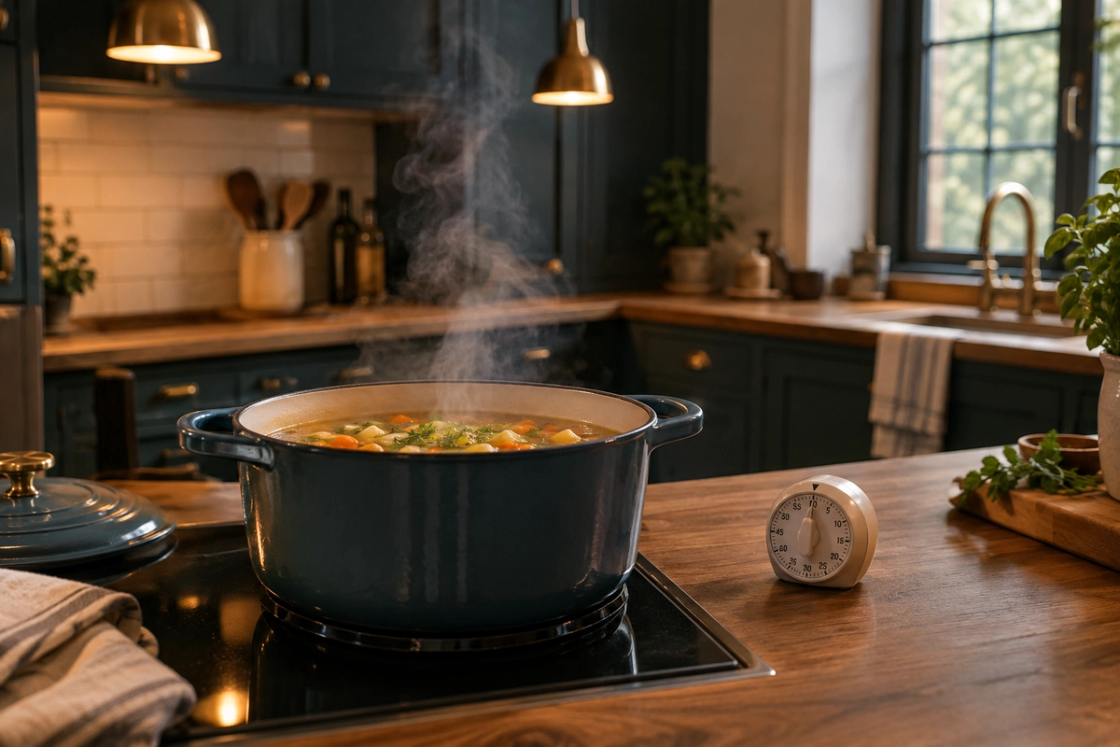
You check the washing, answer one message, sit down for "just a second." Then you look up and twenty minutes are gone. For a lot of neurodivergent cooks, that is not carelessness, it is how time blindness actually works. The stretch between starting dinner and finishing it does not always register the way the clock says it should, and no amount of meaning to concentrate harder changes that.
Some meals shrug this off without complaint. Others punish you for it immediately. Knowing which is which does more for your dinner than trying to become a different kind of cook.
What actually ruins in twenty minutes
A short list of dishes where a wandered-off gap is expensive:
- Anything frying in oil. It goes from golden to burnt in about the time it takes to read one message.
- Stovetop eggs, of any kind.
- Pasta boiling on the stove. It boils over, or turns to paste, or both.
- Toast or anything under a grill.
- Sauces that need stirring so they do not catch on the bottom of the pan.
These are not bad meals. They are simply meals that need you standing there, and standing there for the full length of time is exactly what time blindness makes hard to guarantee. Planning your week around them is planning to fail a roll of the dice most nights.
What forgives you
A short list of dishes with a wide margin either side of "done":
- Slow cooker meals, built for hours of not being looked at.
- Oven bakes, roasts and casseroles at a moderate heat. Most have a ten to fifteen minute window either side of the timer where nothing bad happens.
- Soup or stew on a low simmer with the lid on.
- A rice cooker or automatic pot, which switches itself off when it is done.
- A jacket potato or a tray of vegetables in the oven.
The common thread is heat that is low enough, or contained enough, that "a bit longer" is a shrug rather than a disaster. None of these need a witness.
The swap that matters more than the recipe
You do not need a different cookbook. You need a different default appliance. Moving your go-to dinner from stovetop to oven changes the size of your mistake, not just the method. Frying gives you maybe thirty seconds of grace before it turns on you. An oven at 180°C usually gives you ten or fifteen minutes either side of the timer before anything is actually wrong. That gap is the difference between a ruined dinner and one that is simply ready a bit later than planned.
If a wandered-off twenty minutes is a normal Tuesday for you, and for a lot of us it is, it is worth building your regular meals around appliances that already expect that, rather than meals that assume you will not.
A short kit to keep ready
You do not need to relearn how to cook. You need three or four forgiving dinners in regular rotation, so a low-attention day is not also a food-planning day.
- Sheet-pan chicken thighs and vegetables. 180°C, 35 to 40 minutes, forgives an extra ten easily.
- Slow cooker lentil and vegetable stew. Low for six to eight hours, or high for three to four. There is no real ceiling.
- Oven-baked rice. Rice, stock, and whatever vegetables or protein is on hand, in a covered dish, 180°C for about 35 minutes. No stirring, no boiling over, no standing guard.
- A whole roast vegetable tray with whatever needs using up. Cut it roughly the same size, oil it, and leave it. It is done somewhere between 30 and 50 minutes and tastes fine at either end.
None of these need you in the room for the middle part. All four still taste like dinner, not like a compromise you made because your brain would not cooperate.
If checking whether something has gone off is its own source of decision fatigue on top of this, we covered that separately in "Is This Still Okay to Eat?", which has a few plain rules for turning that into a ten-second check instead of a twenty-minute one.
Cooking around time blindness is not about fixing your attention span. It is about choosing meals that were never relying on it. Less deciding, more eating.