Eating Around a Day of Appointments
A row of appointments eats your meals. Pack the night before, eat on the gap rather than on hunger, and leave something ready for the front door.
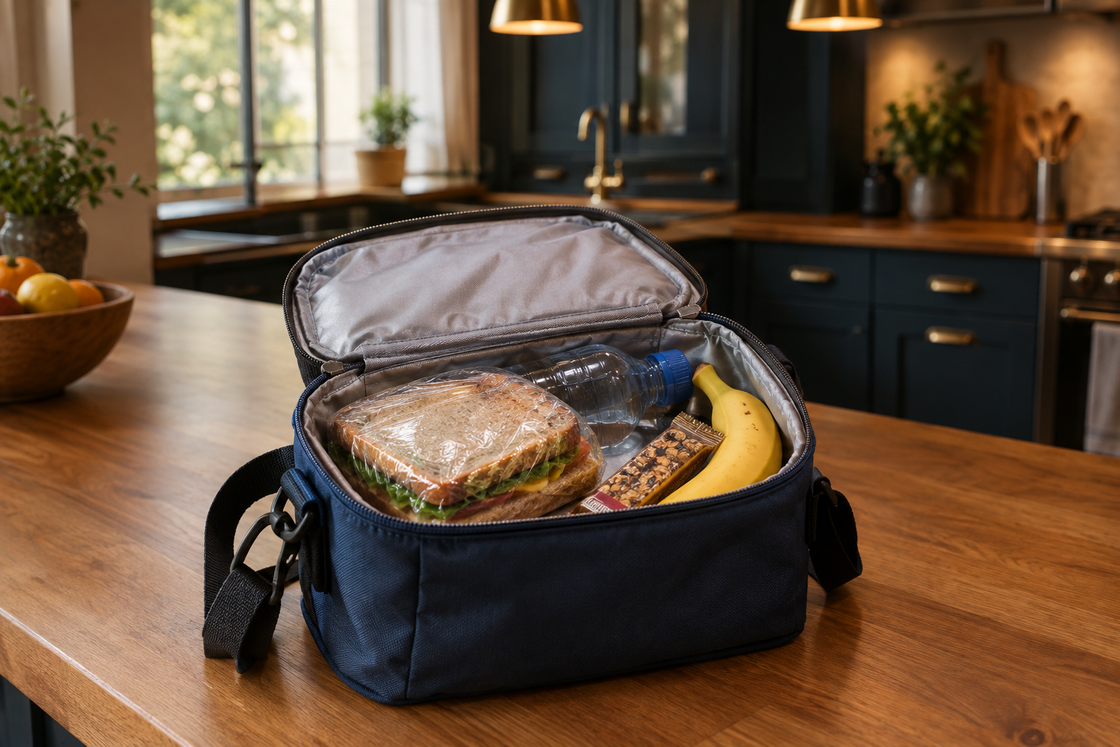
Some days are a row of appointments with travel between them. You leave the house fed, and you get home at four in the afternoon having eaten nothing since breakfast, too flat to do anything about it.
This is not a discipline problem. It is a gaps problem. The windows between appointments are too short to find food in, the food near clinics and offices is often not food you can eat, and by the time there is time, hunger has gone past the point where it prompts you to act.
Pack the night before
On the morning of a heavy day you have exactly enough capacity to get out the door. Anything that needs assembling at 7am will not happen, and you know that already.
The night before, while you are not yet under pressure, put food in a bag. Not a considered lunch — a bag with things in it. Then in the morning you pick up a bag.
What actually survives a day out
The test is not how nice it is. It is whether it still works after four hours in a bag, and whether you can eat it standing in a corridor with one hand.
- Something solid and plain: a sandwich, a wrap, a roll. Nothing that leaks.
- Something you can eat without cutlery: a banana, a mandarin, a muesli bar.
- Something salty, for the afternoon — crackers, nuts, chips.
- Water. More than you think, because the day will be drier than you expect.
- One thing you actually like, so there is a reason to open the bag.
Eat in the gap, not when you are hungry
On a day like this, hunger is an unreliable signal — it arrives late, or not at all, and then all at once. So eat on the gap rather than on the feeling. If there is a twenty-minute window between two appointments, that is lunch, whether or not you want it yet.
A few mouthfuls in a waiting room counts. The aim is to not arrive home empty.
If you could not pack
Some mornings the bag does not get made. That is a normal outcome, not a failure of the system, so it is worth having a fallback that does not depend on finding a good cafe.
A supermarket is almost always a better bet than a food court. It is quieter, the labels are readable, the prices are lower, and you already know what the products are.
- A bread roll, a small block of cheese and a piece of fruit is a meal, costs a few dollars, and needs no ordering conversation.
- Tinned fish with a ring pull, a packet of crackers, a tub of yoghurt with a lid you can drink from.
- A plain sandwich from the refrigerated section beats a made-to-order one when talking is the expensive part.
Ordering at a counter is its own task, with noise, a queue, questions and a decision at the end of it. On a heavy day, the checkout is cheaper than the counter in every sense.
Plan for the arrival home
The hardest moment of these days is the front door. You are done, your capacity is gone, and the kitchen asks you for one more decision.
The fix is made in advance, not in that moment. Before a heavy day, put one thing in the fridge or freezer that needs no thought — leftovers portioned out, something from the freezer shelf, a tin and some bread. Future-you will not be capable of choosing; give them something already chosen.
If nothing is in, order something on the way home rather than after you sit down. Once you sit down, it will not happen.
And the day after
Big days tend to borrow from the next one. Keep the day after a heavy day deliberately empty of anything that needs cooking, and treat that as part of the appointment, not as a failure to recover quickly.
Less deciding, more eating.
Related reading: "The Day After a Big Day" and "When You Forget to Eat Until You're Too Hungry to Cook".