Cooking While Someone Else Is Home
A shared kitchen adds two things a recipe never accounts for: being watched, and being interrupted. Here's how to set up the timing and the bench so the kitchen still feels like yours.
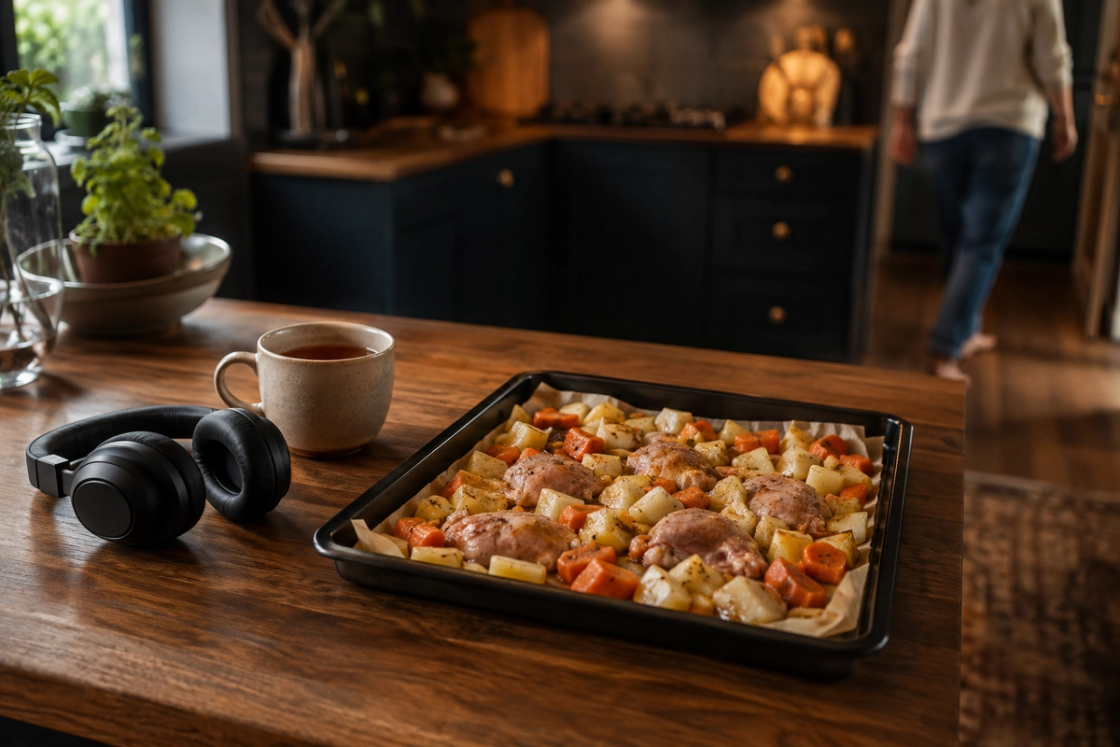
You can know a meal well and still not be able to make it while your housemate is on the couch.
That is not fussiness. Cooking alone and cooking near someone are two different tasks. One is a sequence of steps. The other is a sequence of steps plus a running background process that tracks where the other person is, whether they need the sink, and whether they are about to start a conversation.
That background process is where the energy goes.
What actually makes it harder
It helps to name which part is the problem, because the fixes are different.
- Being observed. Someone can see you stall, re-read the packet, or stand still for a while. Nothing is wrong, but you feel behind.
- Being interrupted. A question mid-step costs more than the question. It costs the place you were up to.
- Stacked noise. Extractor fan, telly, someone chatting, a pan hissing. Any one is fine. All four at once is not.
- Negotiating the space. Waiting for the tap, moving around a body at the fridge, losing your bench to their unpacked shopping.
Most of what follows targets the interruptions and the space, because those two are the ones you can change without asking anyone to be different.
Pick the hour before you pick the meal
Every shared house has quiet windows. The half hour after someone leaves for a walk. The stretch while a show is on. Early evening before everyone lands home.
Find one and treat it as your cooking hour, even if it is earlier than you would normally eat. Food made at 5pm and eaten at 7pm is still dinner.
This is the single biggest lever, and it costs nothing.
Set the whole thing up before you turn anything on
An interruption during chopping is annoying. An interruption while something is browning is a ruined pan and a bad twenty minutes.
So front-load everything that can be paused, and only then start the heat:
- Everything out of the fridge and cupboard first, on one section of bench.
- All the cutting done and sitting in one bowl. Not four small bowls — one.
- Tray lined, oven on, plate already out.
- Then, and only then, the part that needs watching.
The prep half can absorb a conversation. The heat half cannot. Keep the heat half as short as you can.
Cook things that survive being walked away from
On a shared night, choose by how forgiving the method is, not by how good the recipe sounds.
- Oven trays. Chopped veg and a protein at 200°C for 35 minutes. Five minutes either side changes very little.
- Anything simmering with a lid on. Soups, dhal, a pot of rice. It waits for you.
- Assembly, not cooking. Tinned beans, a bag of salad, bread and cheese, last night's rice. No heat means no risk.
Save the stir-fry, the pan sauce and anything you have to stand over for a night when the kitchen is empty.
One sentence that buys you the kitchen
Most people interrupt because there is no signal not to. A short, unloaded sentence at the start does more than an hour of hoping.
I'm going to be in the kitchen for about half an hour. I'll come find you after.
It sets a limit and an ending, which is what makes it land. You are not asking them to leave. You are telling them when you are back.
Headphones do a similar job without words. One ear in, something familiar and low, and the stacked noise drops to one layer you chose.
When you can't get the kitchen to yourself
Some houses do not have a quiet window. A share house with five people, a family kitchen at 6pm, a partner who works at the dining table.
Then shrink the footprint instead of the noise:
- Claim one corner of bench and stay in it. Less moving around people.
- Cook once for three nights when you do get a good window. A double tray now is two nights you don't have to enter a busy kitchen at all.
- Eat somewhere else. Taking the bowl to your room is a reasonable adaptation, not a failure of household life.
- Use the kettle and the toaster. Both are quiet, quick, and need no bench negotiation.
A shape for a shared-kitchen night
If you want one plan rather than a set of principles: line a tray. Tip on chopped potato, carrot and whatever protein you have. Oil, salt, into a 200°C oven for 35 minutes. Say the sentence. Put your headphones on. Come back when the timer goes.
Total time standing in a shared kitchen: about eight minutes. That is the whole trick.
The kitchen does not have to be empty to be yours. It has to be predictable for the short stretch you are in it.
Related reading: "When You Lose Track of Time in the Kitchen" — on meals that forgive a lost twenty minutes.
Also from this week: "Father's Day Lunch Without the Overwhelm" — food with other people around, on terms you set.